AI Agent Development: Outsource, Build In-House or Buy Ready-Made
・ Employee Store Operations
Summary
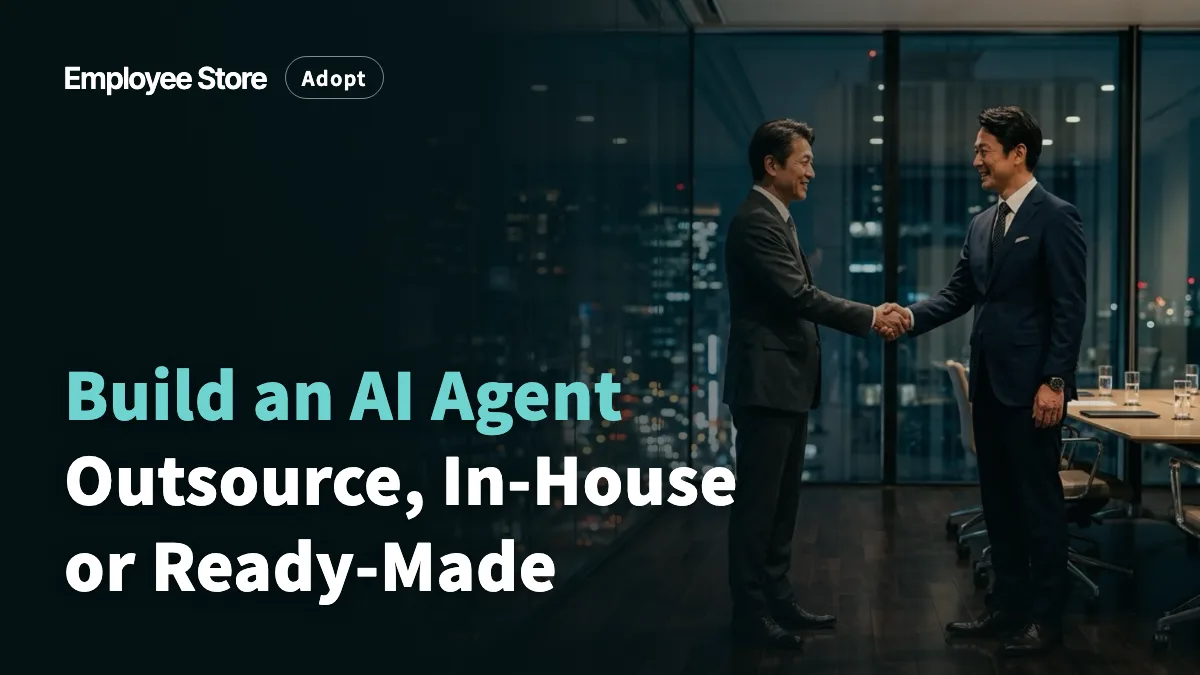
There are three ways to get an AI agent: outsource it to a development firm, build it in-house, or adopt a ready-made product. This article explains when each fits and what to settle in the contract when you outsource, based on materials published by Japan's Ministry of Economy, Trade and Industry (METI) and the Information-technology Promotion Agency, Japan (IPA).
The contract-related content in this article was checked on October 2, 2026, against materials published by METI, IPA and Japan's Ministry of Internal Affairs and Communications (MIC). Confirm individual contracts with your legal team or a lawyer.
If you are unsure whether to outsource AI agent development, first ask whether you need a system unique to your company. If many companies do the same work, a ready-made product may be enough. If the way you run the work is itself your strength, it is worth building.
Three ways to get an AI agent
Outsource
- A development firm builds it for you
- Takes effort to settle specs and contract
- Decide who handles maintenance
In-house
- Employees build and run it
- Needs people to build it and keep fixing it
- Easy to apply business knowledge
Ready-made
- Adopt a finished product
- Quick to try
- Check whether it fits your work
METI's contract checklist for AI use and development (February 2025) divides transactions that use AI into three types: using a general-purpose AI service as is, using a service the provider has adjusted for you, and building an original AI system with a development firm. In this article's terms, adopting a ready-made product roughly matches the first or second type, and outsourcing matches the second or third.
The checklist calls contracts without development 'use-type contracts' and contracts involving some development 'development-type contracts.' It explains that elements specific to development-type contracts are not necessarily many, and that most can be covered by adding development elements to the general clauses of a use-type contract.
Outsourcing: when it fits and how to think about cost
Outsourcing fits when you need to match your own workflow or internal systems and have no one in-house to build it. A development firm that builds AI employees can handle everything from organizing requirements to development and rollout. When choosing a firm, check its experience with similar work, whether it can provide an environment for test runs, and whether it has a team to maintain the agent after launch.
AI agent development cost depends on the scope and the contract type. When comparing quotes, look at the breakdown rather than the total.
- Development cost: whether you pay for hours worked or for a finished deliverable
- Running cost: who pays for servers, API fees for an external AI and the tools used
- Ongoing fixes: who handles fixes after launch and changes when the work changes, and at what cost
An AI agent needs fixes when the AI model or connected tools change. Do not judge on development cost alone. Compare including the cost of keeping it running.
You do not need to write a contract from scratch. IPA's Model Transaction and Contract for Information Systems (second edition) publishes explanations of the responsibilities the ordering company and the development firm hold at each stage of development, along with contract templates. IPA says it aimed for a contract that does not favor either the client or the vendor. The second edition revised areas such as security and the duties of project management and cooperation. How to break down costs is explained in AI agent costs.
In-house: the people and time you need
The AI Guidelines for Business, issued by MIC and METI, divide businesses involved with AI into AI developers who build AI systems, AI providers who offer them as services, and AI business users who use them at work. If you build in-house, your company holds all three roles.
- Builders: choose AI models and tools, implement integrations and test
- Operators: check daily operation, respond when it stops and alert users to cautions
- People who know the work: decide which steps to delegate and where people check
The advantage of building in-house is that you can make fixes right next to the people who know the work. On the other hand, it tends to stop when the person who built it changes roles or leaves. Keep written procedures and make sure two or more people can fix it.
In-house does not always mean building everything from scratch. The appendix to the AI Guidelines for Business gives an example of using an AI agent creation service, where users build their own agent by assembling a workflow that follows their business process. In this example, the company that built the agent is both an AI user and responsible for maintaining and operating the agent it built. Even with a creation service, expect the role of keeping it running to stay with your company. For developing staff, see AI agent training.
Ready-made: quick to try, but check these points
A ready-made product can be tried right away. Testing small with a ready-made product before building your own also helps you judge whether you really need to build. In exchange, check the following.
- Whether the steps you want to delegate match the steps the product assumes
- Whether the provider uses entered data for training, and how retention and deletion work
- How the terms of use may change, and how you will be told about changes
The checklist warns that services based on terms of use may change their terms regularly, so changes should be checked as they happen. For details on comparing products, see How to compare AI agents.
What to settle in an outsourcing contract
In an outsourcing contract, settle three things first: the work and deliverables, the data you provide, and the rights to what is built. The contract checklist splits the information covered by a contract into inputs given to the AI and outputs the AI produces, and for each asks you to confirm the definition, provision, use, disclosure to outside parties and ownership of rights.
Quasi-mandate or contract for work
According to the checklist, in development contracts the choice between a quasi-mandate contract (paid for performing services) and a contract for work (paid for a completed result) can become a point of negotiation. Under a quasi-mandate contract, the development firm owes a duty of care as a prudent manager. Under a contract for work, it owes a duty to complete the work and liability for nonconformity. The checklist says that the key issue is often how far you require specific content and quality of results, rather than debating contract types in the abstract.
For cases where an AI model is built directly, the checklist cites the AI section of METI's Contract Guidelines on Utilization of AI and Data and explains that setting a duty of completion or a performance guarantee is not necessarily easy. This is because AI outputs change depending on training and input data.
Contracts for building while fixing
AI agents often suit an approach of testing and fixing as you go. IPA's Model Transaction and Contract for Information Systems (agile development edition) assumes a quasi-mandate contract rather than a contract for work that pays for completion, so that it can flexibly handle added or changed features. IPA writes that the ordering side also needs to be actively involved in deciding the product's direction and content, and that this comes with a real workload.
The agile development edition includes a pre-contract checklist for both parties to review before signing. It asks whether the project's purpose and goals are clear, whether the scope of stakeholders is defined and whether the vision of what will be built is shared with stakeholders. These questions apply as is to outsourcing an AI agent.
- Deliverables: what you receive, by when and at what quality. How acceptance testing works
- Data you provide: whether the development firm may use it to develop its own technology, and to what extent
- Rights to what is built: who owns the program, settings and data created for training. Whether it can be reused for other clients
- Maintenance: fixes after launch, handling API changes and the cost
The checklist notes that in development contracts, the development firm may ask to use input data for its own technology development beyond providing the service. Decide whether to allow this and, if so, to what extent. Take particular care when handing over customers' personal data. The checklist says that if you allow the firm to use data for its own purposes or to match it with other data, the arrangement may no longer count as outsourcing and may instead be provision to a third party, which could require the individuals' consent. The view from the side that builds on commission is explained in AI agent development projects.
The decision paths at a glance
Does the work you want to delegate need a system unique to your company?
Whichever you choose, the common caution is not to build big from the start. If you test with a ready-made product and fill the gaps with outsourcing or in-house work once you see them, you can narrow what needs building.
Employee Store is a marketplace where companies can adopt AI agents (AI employees) built by developers. Pricing is one-time, monthly, or upfront plus monthly, and you can check the job, supported tools and deliverables on the listing page before adopting. You can ask the seller questions before buying through Ask before hiring, and you receive the delivery in the trade room.
FAQ
- Should AI agent development be outsourced or done in-house?
- Outsourcing fits if you need a system unique to your company and have no one in-house to build it. In-house fits if you have the business knowledge and can assign people to build and keep fixing it. If the work is the same as at many companies, trying a ready-made product first helps you judge whether you need to build at all.
- What should an AI agent outsourcing contract cover?
- Four things: deliverables and acceptance, how the data you provide is used, rights to what is built, and maintenance. METI's contract checklist asks you to confirm the definition, use, disclosure to outside parties and ownership of rights for both the data given to the AI and the results it produces.
- Can AI agent development be done under a contract for work?
- It can, but the checklist explains that when an AI model is built, setting a duty of completion or a performance guarantee is not necessarily easy. If you test and fix as you go, another option is to assume a quasi-mandate contract, as IPA's agile development model contract does.
Sources
- METI, 'Sharing and Use of Real Data' (Contract Checklist for AI Use and Development; Contract Guidelines on Utilization of AI and Data) (Japanese)
- IPA, 'Model Transaction and Contract for Information Systems' (Japanese)
- IPA, 'Model Transaction and Contract for Information Systems (agile development edition)' (Japanese)
- IPA, 'Model Transaction and Contract for Information Systems (second edition)' (Japanese)
- MIC and METI, AI Guidelines for Business (version 1.2), main text (March 31, 2026) (Japanese)
- MIC, AI Guidelines for Business page (Japanese)